
informational 7 min read
Snorkelling and Diving in Santorini
Updated October 27, 2026
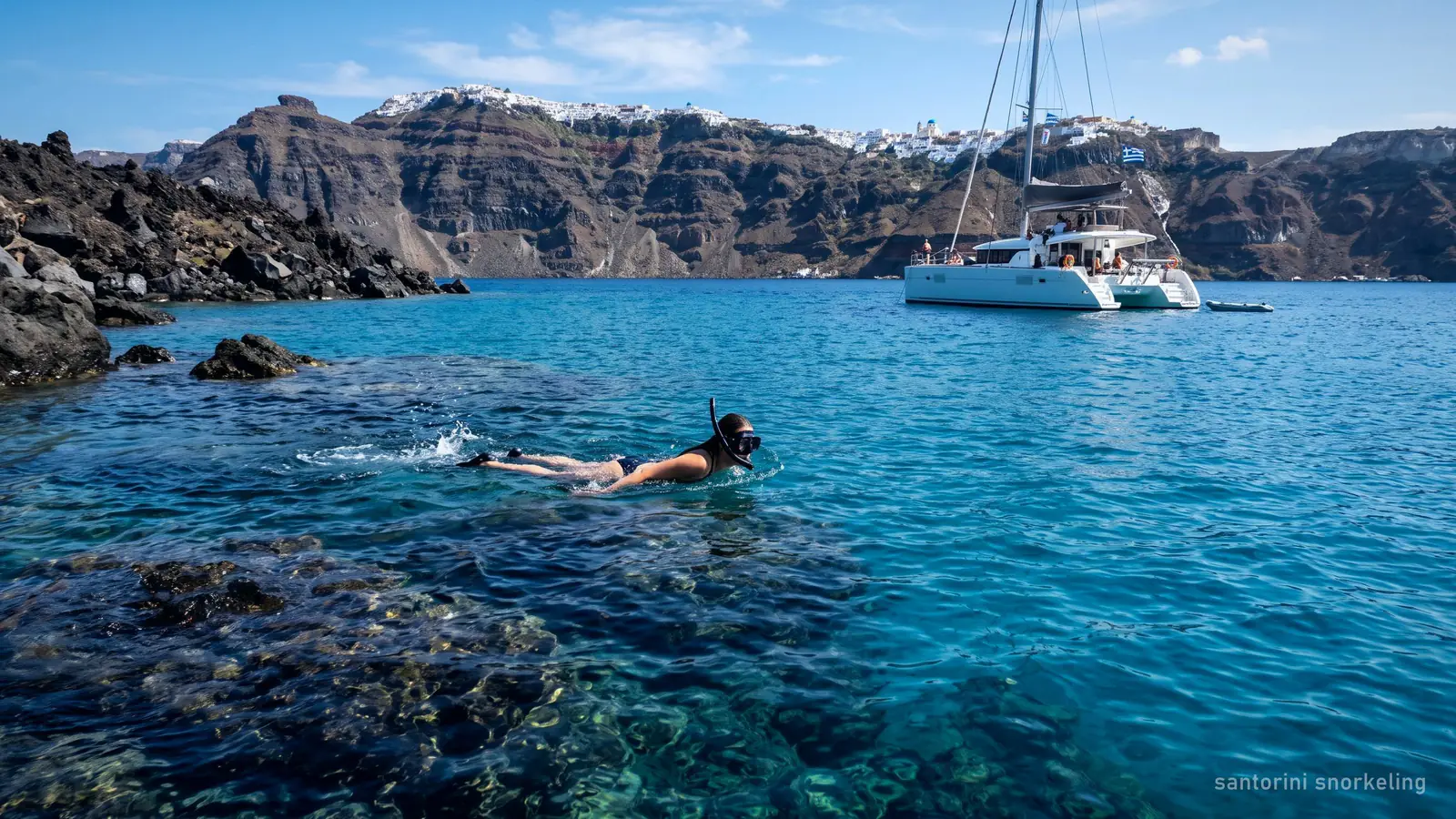
Santorini is good for snorkelling if you want clear water and dramatic rock, and less good if you want fish and coral. The caldera is a flooded volcano. What you see underwater is lava, cliffs and sea caves. Most catamaran cruises stop two or three times to swim and snorkel, and most include the mask and snorkel.
What is down there
Dive operators are candid about it. One says “the biggest interest for a diver is the underwater geomorphology”. A dive guide to the island notes that coral is less common than in tropical seas. Expect dark volcanic boulders, walls that drop away fast, and caves. Divers report groupers, moray eels, octopus and nudibranchs, with dolphins sighted now and then.
The depth is part of the drama. The caldera is about 12 by 7 km and reaches 385 m at its deepest. Its cliffs rise about 300 m above the water. You are snorkelling over the edge of a very deep basin.
Visibility is high. Published figures range from about 20 m in one dive directory to “often exceeding 30–40 metres” in a regional dive guide. The low end is the safer figure to plan on.
Where the boats stop
Catamarans do not land on the beaches. Three of the listings say so in the same words: they “cannot moor directly on the beaches visited”, so the operator picks points “as close as possible to the beach”. You swim from the boat.
Red Beach. Red volcanic cliffs and a small beach. Most day and sunset catamarans stop here. The sunset catamaran’s listing gives it 30 minutes. See Red Beach.
White Beach. Tall white cliffs, reachable only from the sea. The luxury catamaran snorkels in its sea caves. See White Beach.
Mesa Pigadia. A bay the sailing catamaran’s listing describes for its black rock and caves. The day catamaran serves lunch here, and the sailing catamaran stops to swim.
Black Mountain (Mavro Vouno). A swim stop on the wooden boat route and one of the places the boat rental suggests.
Thirassia. The island across the caldera. The wooden boat and the private catamaran stop to swim here. See Thirassia.
The hot springs. Not a snorkelling stop, but almost every cruise includes it. Boats wait about 50 m away and you swim in. The water is up to about 4°C warmer than the open sea and can stain a light swimsuit. See the hot springs.
How long you get in the water
Less than you might hope. Travellers on the sunset, day and sailing catamarans all say, in GetYourGuide’s review summaries, that more time at each swim stop would help. One sailing catamaran reviewer timed the first two stops at about 10 and 5 minutes, against 30 on the listing. The last stop, over lunch, ran much longer.
If snorkelling is the point, two choices give you more control:
- A private boat follows your plan. The private catamaran includes snorkel gear and a stand-up paddleboard, from $129 per person.
- A boat rental lets you stay at each spot as long as you like. It costs $291 per boat for up to 5 people, with snorkel gear and waterproof phone cases included and fuel extra. No licence is needed.
Which cruises include the gear
| Cruise | From | Snorkel gear on the listing |
|---|---|---|
| Day catamaran | $95 | Yes, plus pool noodles |
| Luxury catamaran | $123 | Yes, plus flotation devices |
| Small-group catamaran | $145 | Yes, ask the crew |
| Sailing catamaran | $85 | Yes, plus swimming aids |
| Private catamaran | $129 | Yes, plus a paddleboard |
| Wooden boat | $112 | Yes |
| Boat rental | $291 per boat | Yes |
| Sunset catamaran | $88 | Not listed; it stops to swim and snorkel |
| Volcano and hot springs | $34 | No; pool noodles only |
The day catamaran is rated 4.82 on 3,573 reviews of that cruise on GetYourGuide, with snorkelling in its title. All of these show free cancellation up to 24 hours before.
When the water is warm enough
The sea averages 16°C from January to April, 19°C in May, 22°C in June, and 24°C in August and September, according to weather2travel. October drops back to 22°C. WeatherSpark puts the sea above 23°C from 25 June to 6 October. The best time page has the full year.
Scuba diving
Dive centres on the island run trips to sites around the caldera, with options for every level. One regional dive guide lists these:
- Nea Kameni: lava flows, caves and three wrecks. The Santa Maria, a 34 m steel passenger ship sunk in the Second World War, sits upright at about 18 m.
- Palea Kameni: wall dives along the caldera, 15 to 40 m and deeper. For intermediate and advanced divers.
- Kamari reef: shallow and sheltered, 5 to 18 m. Used for beginners and training.
- Vlychada: an artificial underwater park with statues and amphorae, 10 to 15 m.
- Aspronisi: about nine sites at 7 to 30 m.
The same guide gives April to November as the main diving season. No scuba trips appear among the listings we track, so book with a dive centre directly. If you have not dived before, a catamaran with snorkel stops is the easier way to see the caldera from below.
Frequently asked questions
Is there good snorkelling in Santorini?
Good for rock and clear water, thin on fish and coral. What you see is volcanic geology: walls, boulders and sea caves. Dive operators say the geology is the main interest.
Which Santorini cruises include snorkel gear?
The day, luxury, small-group, sailing and private catamarans, the wooden boat and the boat rental all list snorkel equipment. The sunset catamaran and the two volcano trips do not.
How clear is the water?
Published visibility figures vary from about 20 m to 30 to 40 m, depending on the source and the day.
Can you scuba dive in Santorini?
Yes. Dive guides list sites around Nea Kameni, including a Second World War wreck at about 18 m, walls off Palea Kameni, and a shallow reef at Kamari for beginners.
Sources